Our solution, the Continuous Community Review Compendium, is a website that connects academic articles directly to their peer reviews. It modernizes the peer review process by making reviews transparent, searchable, and easy for student to learn to write their own, solving key challenges identified by our client.

The platform provides a secure environment for uploading articles, submitting peer reviews, exploring feedback, and identifying AI-generated or low-credibility content. By gathering articles and reviews into one accessible system, the solution supports both research workflows and peer review education within the client's lab.

The Continuous Community Review Compendium is designed to modernize the peer review process by providing a transparent, searchable, and educational platform where articles and peer reviews coexist. It gives students the ability to learn peer review through exposure to real examples while giving researchers a centralized place to publish feedback and identify AI-generated or low-credibility work.

Overall it:

  • Improves transparency in scientific communication.
  • Teaches students how to write proper peer reviews through guided practice.
  • Reduces duplicated reviewing efforts across research labs.
  • Helps researchers quickly evaluate article credibility through flags and review records.

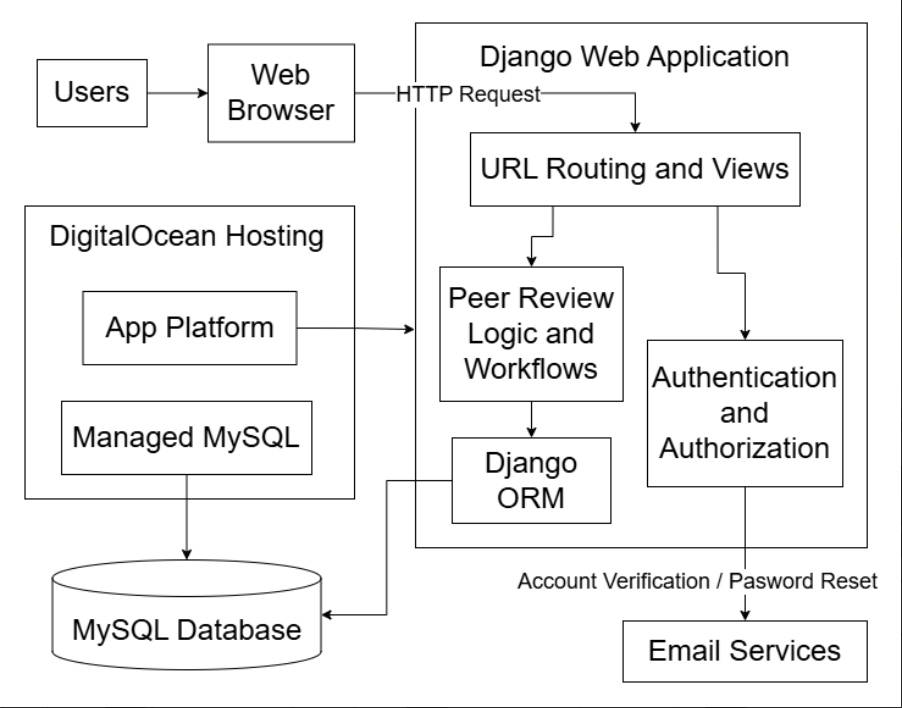
The system is built using a four-layer architecture that supports scalable growth across Northern Arizona University departments and research groups.

  • User Interface Layer: The browser-facing portion of the system where users upload articles, submit peer reviews, and browse content.
  • Application Layer (Django): The core logic that handles authentication, form submissions, article management, peer review workflows, search operations, and advisor verification. This layer also integrates middleware such as search handling and ReCAPTCHA email authentication.
  • Database Layer: Stores article metadata, uploaded files, peer reviews, user accounts, advisor linkages, and credibility flags. Managed through a dedicated database hosting service.
  • Deployment & Hosting: The system is deployed on cloud hosting. Initially, it was hosted on PythonAnywhere for rapid development, then migrated to a DigitalOcean App for improved scalability and reliability.

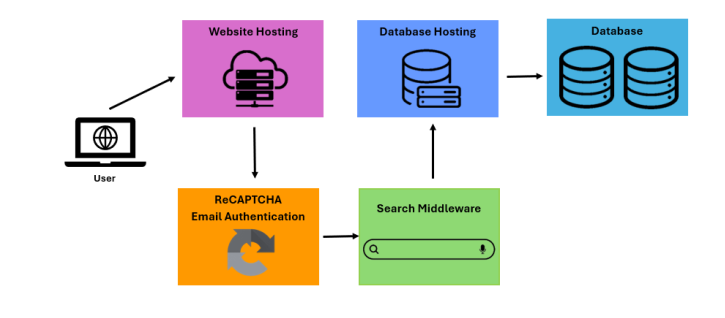
Software Interaction Diagram:

The diagram shows how users interact with the hosted web application, authentication services, search middleware, and the database layer.
Software Interaction Diagram

Figure 2: Architecture Diagram. A diagram displaying the current process of our system and how the layers connect.

For more technical information that relates to specifics of our architecture (including technologies used to support it), please see:

Technical
  • Secure Authentication: Student accounts are verified through a faculty advisor (guarantor).
  • Article Repository: Upload, store, browse, and view academic articles with tags and metadata.
  • Peer Review System: Write, edit, store, and view peer reviews associated with each article.
  • AI Credibility Flags: Highlight articles that may contain AI-generated content.
  • Search & Filtering: Locate articles by title, author, keywords, or research category.
  • Citation Tools: Automatically generate formatted citations for any stored article.
Pain Impact of Our Solution
No infrastructure for teaching peer review. Students learn by reading real reviews and submitting practice reviews overseen by advisors.
Peer reviews rarely accompany the published article. Reviews remain permanently linked to articles in a transparent, accessible system.
AI-generated articles threaten scientific credibility. Articles can be flagged for AI involvement, improving trust and transparency.
Researchers waste time reviewing papers already identified as low-quality. Flags and existing reviews help researchers prioritize credible work and reduce redundancy.

Overall, the system enhances research quality, reduces redundancy, and supports peer review training as envisioned by our client.