Project Information

Project Description

Beyond Bridges has designed and constructed a 1:10-scale steel bridge model representing a full-scale pedestrian bridge to be placed in El Paso, Texas. The pedestrian bridge addresses the current safety hazards and disconnect of the area's communities to provide reliable crossing over the Rio Grande. The scaled model serves as a platform for evaluating loading conditions, structural behavior, constructability, cost efficiency, and overall project feasibility.

The bridge was designed in accordance with the specifications of the American Institute of Steel Construction (AISC), the American Society of Civil Engineers (ASCE), as well as criteria set by our client. Upon completing fabrication, the team traveled to compete at the Intermountain Southwest Student Symposium (ISWS) in Salt Lake City, Utah, where the bridge prototype was evaluated in the following categories: aesthetics, weight, structural efficiency, construction speed, construction economy, cost estimation, and stiffness. 
Project Constraints

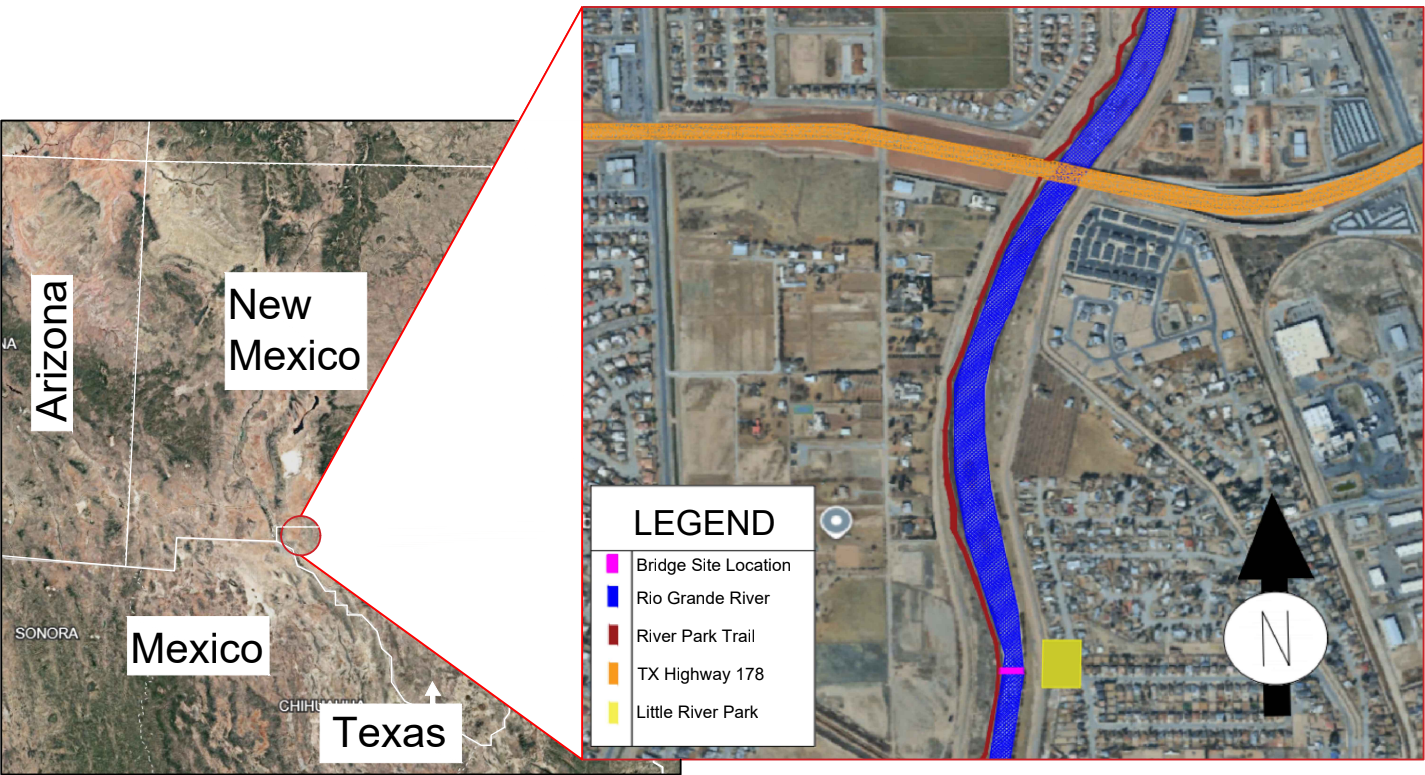
Project constraints include specific dimension requirements and construction restrictions. Dimension specifications include a minimum clearance and designed locations for the footings. Construction restrictions prohibit c​​onstruction in the riverbanks as well as temporary piers.

Tasks

Beyond Bridges has concluded that a total of nine tasks must be completed for the project to be successful. These nine tasks have been detailed to clarify what this project includes and excludes.

Task 1: Background Research

Subtask 1.1: Truss Type Research
This task aims to research underslung truss bridge types by reviewing articles and documents, focusing on Warren, Howe, and Pratt truss designs.
Subtask 1.2: Material and Member Research
This task involves researching steel material types to understand how they affect bridge load capacity, focusing on the steel options and members provided by Page Steel.
Subtask 13: Connection Research
This task aims to identify the most suitable connection type for the project by comparing bolts and welds and evaluating their advantages and disadvantages.

Task 2: Material and Member Research

Subtask 2.1: Preliminary Sketches
This task involves sketching initial bridge concepts to explore aesthetics, truss designs, and overall layout using competition dimensions and prior research.
Subtask 2.2: Member and Connection Selection
This task evaluates which members and connections suit each design by using prior research and sketches to assess feasibility and prepare for easier modeling in the next task.
Subtask 2.3: Modeling and Analysis
This task models each preliminary bridge design in RISA-2D to get a basic understanding of load performance and identify the strongest truss among roughly three options.
Subtask 2.4: Design Selection
This task selects the best of the three initial designs using a weighted decision matrix based on competition criteria, with the highest-scoring design advancing for further analysis.

Task 3: Final Analysis and Design

Subtask 3.1: Final Analysis
This task uses STAAD to model the bridge in 3D and evaluate member forces and overall deflection under load.
Subtask 3.2: Final Member and Connection Design
This task finalizes member and connection types and sizes by using STAAD forces, creating FBDs for each connection, and checking all AISC failure modes.

Task 4: Shop Drawings

This task produces detailed shop drawings in AutoCAD, showing all fabrication requirements including member dimensions, angles, and bolt and weld specifications.Sample text. Click to select the Text Element.

Task 5: Coordination and Fabrication 

Subtask 5.1: Page Steel
This task involves coordinating with Page Steel to confirm available materials and send them the finalized list of prototype members.
Subtask 5.2: Copper State
This task confirms Copper State’s available inventory and requests the necessary connection materials by contacting them and sending a finalized list.
Subtask 5.3: Flagstaff High School
This task has Flagstaff High School fabricate the prototype using the shop drawings from Task 4 and the materials supplied by Page Steel and Copper State.
Subtask 5.4: Inspections and Corrections
This task inspects the fabricated prototype to identify weak welds or incorrect bolts, allowing fixes or remodels if needed, by checking each member during and after fabrication.

Task 6: Competition

Subtask 6.1: Practice Competition
This task evaluates and improves the team’s bridge assembly speed and accuracy through multiple practice sessions, assigning roles and involving mentees as needed.
Subtask 6.2: Poster Design
This task creates a 2’×3’ poster that explains the bridge design, including dimensions, connection decisions, sustainability considerations, and visual diagrams.
Subtask 6.3: Competition Day
This task involves competing in the event by transporting the disassembled prototype, presenting the poster and bridge for aesthetic judging, assembling the bridge on-site, and undergoing load testing based on competition criteria.

Task 7: Project Impacts

The purpose of this task is to evaluate the project's impacts. This will be accomplished by determining the environmental, economic, social, and global impacts of the final bridge design.

Task 8: Capstone Deliverables

Subtask 8.1: 30% Deliverables
This task prepares the 30% submittal by compiling all work from Tasks 1 and 2 into a report, allowing reviewers to provide feedback that helps guide the team toward meeting the client’s needs.
Subtask 8.2: 60% Deliverables
The task involves preparing the 60% submittal for the third week of March by compiling a report that includes work from Task 3 and Task 4, along with any updates or adjustments based on feedback from the 30% submittal. 
Subtask 8.3: 90% Deliverables
The task involves preparing the 90% submittal by the fourth week of April by compiling work from Task 5 and Task 6 and addressing feedback from the 60% deliverable. 
Subtask 8.4: Final Deliverables
The task involves finalizing the report, presentation, poster, and website by addressing feedback from the 90% deliverable, publishing the project online, and creating materials that summarize the entire project.

Task 9: Project Management

Subtask 9.1: Schedule Management
The task focuses on team organization through schedule coordination and time management for task completion.
Subtask 9.2: Resource Management
The task ensures responsible use of project resources by managing time and computer/software usage effectively.
Subtask 9.3: Meetings
Beyond Bridges will hold meetings with the client, advisors, and team to share progress, plan next steps, and gather feedback.

Exclusions

This project excludes full-scale bridge drawings, anchored footings, and life-cycle cost analysis, focusing instead on testing a 1:10 scale bridge model per ASCE competition rules.

Project Schedule

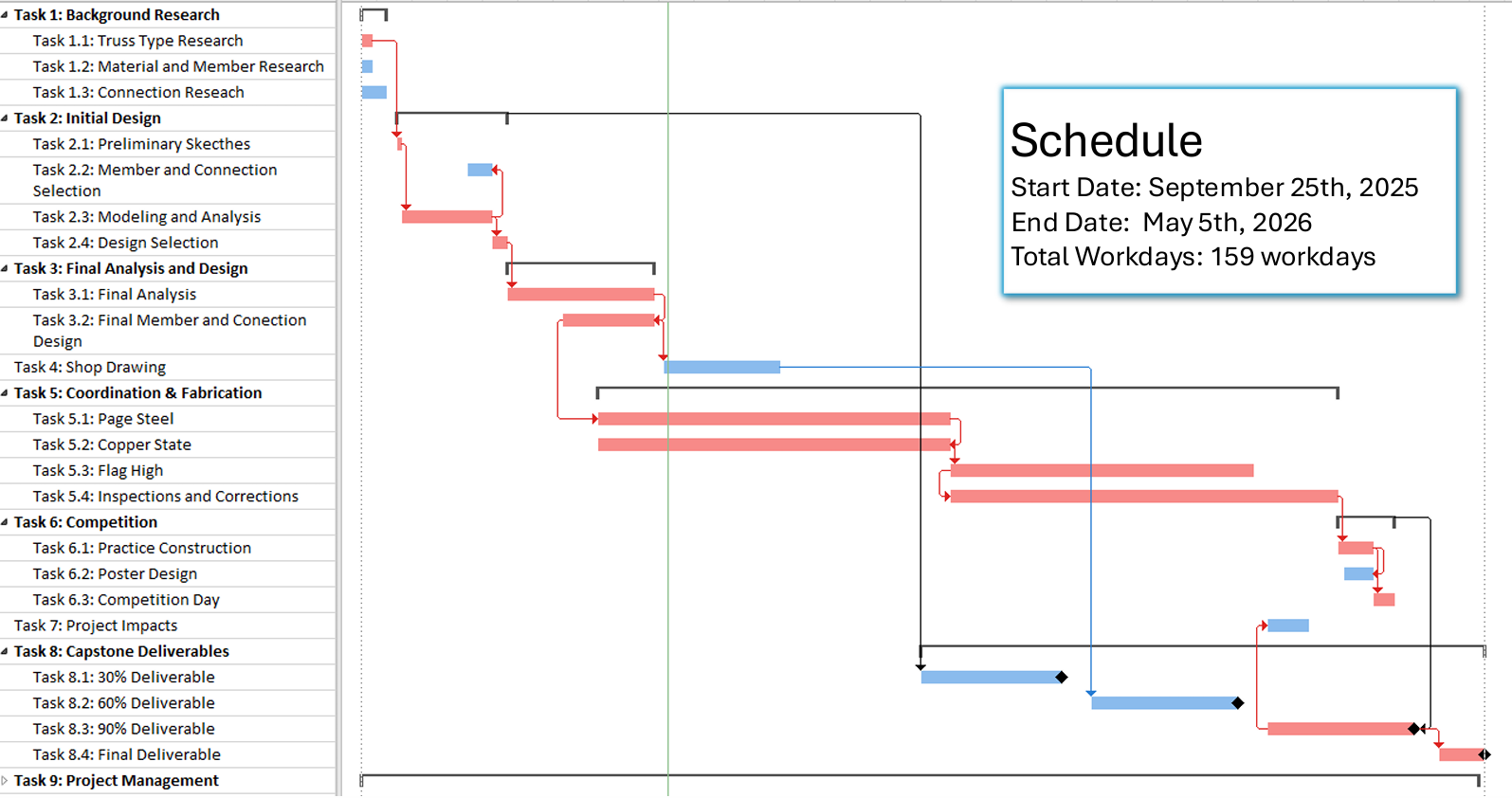
Beyond Bridges compiled all the required tasks and created a Gantt Chart in order to organize the project's schedule. The red seen in the chart the project's critical path. This path identified the major tasks that must be done in time in order for the project to not be delayed.

Staffing

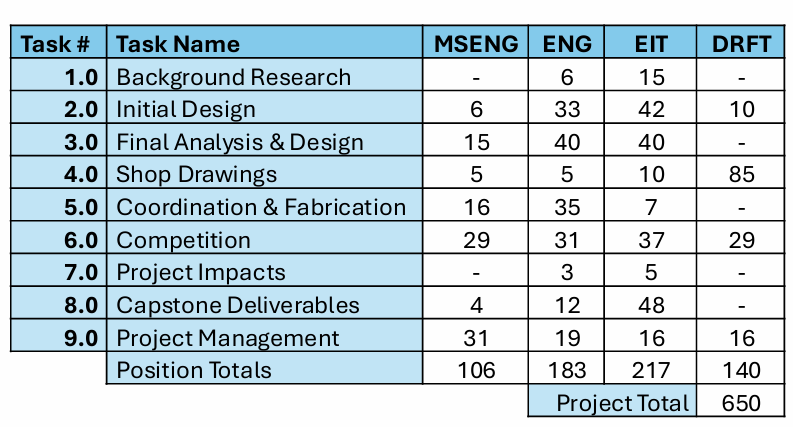
Staffing Hours Estimate

Cost of Engineering Services

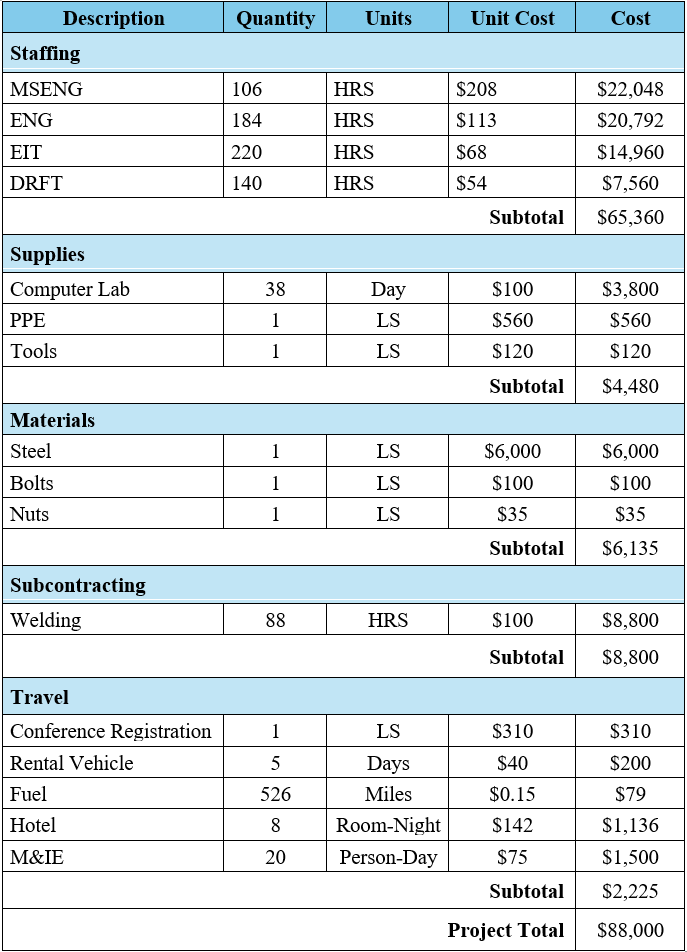
Our cost of services considers the staffing hours, supplies, materials, subcontracting, and traveling required for this project. The total resulting from the sum of these categories was estimated to be $87 thousand dollars. The cost breakdown of this is detailed in the following table.
Cost Breakdown Table