Detailed overview of the NAU 2026 Concrete Canoe Project
The 2026 NAU Concrete Canoe project challenges students to push the boundaries of material science. Our objective is to design, construct, and race a fully functional canoe made entirely of concrete. The project culminates at the 2025-2026 ASCE Intermountain Southwest Student Symposium (ISWS).
Photo from 2025 ASCE ISWS Competition
The project must strictly adhere to the comprehensive 2026 ASCE Concrete Canoe Competition Rules. This includes specifications for hull dimensions, concrete mixture proportions, reinforcement materials, and safety protocols. Any violation can lead to disqualification.
The concrete mixture must have a density lower than that of water (< 62.4 lb/ft³) to ensure the canoe floats even when fully submerged (swamped). This requires the use of lightweight aggregates and careful mix design.
The canoe length is restricted to a maximum of 22 feet. The width and depth must also fall within specified ranges to ensure fair competition and transportability. Optimization of these dimensions is key for speed and stability.
The total value of materials used in the final product cannot exceed $5,000. This constraints challenges the team to find cost-effective solutions and secure donations without compromising on performance or quality.
The entire project, from design to fabrication, must be completed by April 2026 for the ASCE Intermountain Southwest Student Symposium. Strict adherence to the critical path schedule is essential to meet this deadline.
A mandatory 6-inch freeboard is required to prevent water from entering the canoe during races. Additionally, all construction activities must follow rigorous safety standards to protect team members.
This foundational phase ensures the project adheres to strict safety and regulatory standards. The team conducts an exhaustive review of the 2026 ASCE Rules to identify critical design constraints while simultaneously securing funding and establishing lab safety protocols.
The core technical challenge involves engineering a specialized lightweight concrete composite. Through iterative testing, the team develops a mix that maintains buoyancy (density <80 lb/ft³) without compromising the structural integrity required to survive race loads.
Using advanced computational modeling, the team designs a hull optimized for hydrodynamic efficiency. We utilize Finite Element Analysis (FEA) to simulate stress distribution, ensuring the vessel remains stable and fast during sprint and slalom races.
This phase translates the digital design into a physical product. It requires precision mold fabrication followed by 'Pour Day'—a coordinated team effort to batch, place, and finish the concrete canoe to aesthetic perfection.
The project culminates at the ASCE Intermountain Southwest Student Symposium (ISWS). The team transports the canoe to the venue to compete against regional universities in technical presentations and dynamic racing events.
Engineering does not happen in a vacuum. We evaluate the project's broader footprint, analyzing the environmental sustainability of our materials, the economic efficiency of our budget, and the social impact on the engineering community.
To meet academic and competition standards, the team produces a suite of professional technical documents. These reports track our progress and serve as the official qualification record for the ASCE competition.
Effective management ensures the project remains on schedule and within budget. This involves continuous resource tracking, critical path analysis, and regular coordination with our technical advisors and stakeholders.
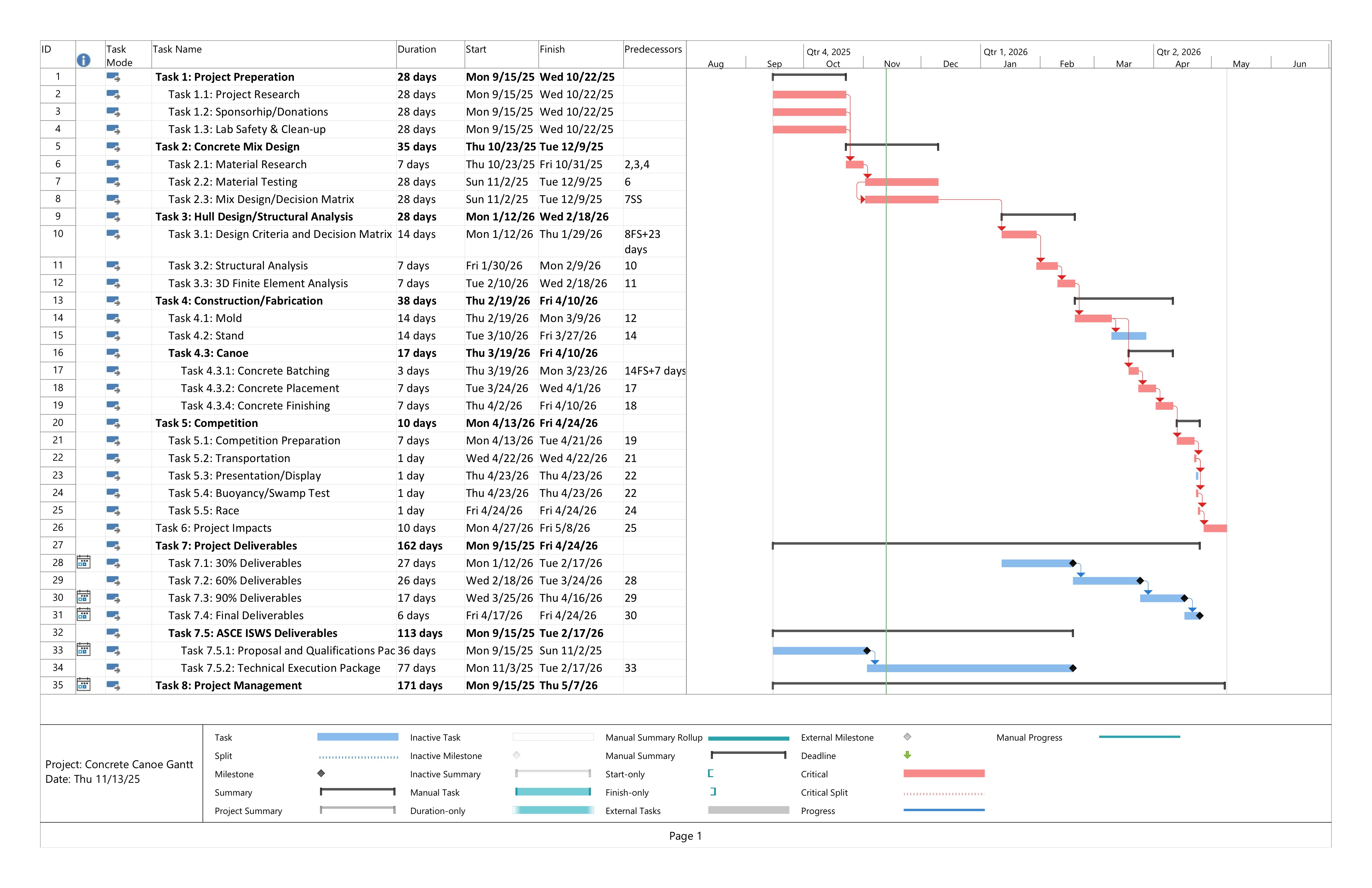
| Task Name | Start Date | Finish Date | Time to Completion |
|---|---|---|---|
| Project Preparation | 09/15/25 | 10/20/25 | 35 Days |
| Concrete Mix Design | 09/22/25 | 01/15/26 | 115 Days |
| Hull Design | 10/01/25 | 12/15/25 | 75 Days |
| Construction | 01/20/26 | 03/10/26 | 49 Days |
| Competition | 04/10/26 | 04/13/26 | 3 Days |
| Position | Abbr. | Key Qualifications | Primary Responsibilities |
|---|---|---|---|
| Senior Engineer | SENG |
|
|
| Project Manager | PM |
|
|
| Engineer in Training | EIT |
|
|
| Lab Technician | TECH |
|
|
| Quality Manager | QM |
|
|
| Task Name | SENG (Hrs) | PM (Hrs) | EIT (Hrs) | TECH (Hrs) | QM (Hrs) | Subtotal (person-hours) |
|---|---|---|---|---|---|---|
| Task 1: Project Preparation | 5 | 15 | 20 | 10 | 5 | 55 |
| Task 2: Concrete Mix Design | 15 | 25 | 50 | 60 | 35 | 185 |
| Task 3: Hull Design/Structural Analysis | 15 | 10 | 45 | 15 | 15 | 100 |
| Task 4: Construction/Fabrication | 10 | 30 | 50 | 55 | 40 | 185 |
| Task 5: Competition | 2 | 10 | 15 | 5 | 5 | 37 |
| Task 6: Project Impacts | 3 | 10 | 10 | 0 | 10 | 33 |
| Task 7: Project Deliverables | 15 | 35 | 40 | 15 | 5 | 110 |
| Task 8: Project Management | 5 | 20 | 10 | 5 | 5 | 45 |
| Total Hours | 70 | 155 | 240 | 165 | 120 | 750 |
| Category | Rate, $/Unit | Quantity | Unit | Subtotal |
|---|---|---|---|---|
| 1.0 Personnel | ||||
| SENG | $217 | 70 | HR | $15,190 |
| PM | $170 | 155 | HR | $26,350 |
| EIT | $133 | 240 | HR | $31,920 |
| TECH | $133 | 165 | HR | $21,945 |
| QM | $130 | 120 | HR | $15,600 |
| Total Personnel | $111,005 | |||
| 2.0 Travel | ||||
| Mileage | $0.7/mile | 1000 | MILE | $700 |
| Van Rental | $62/day | 4 | DAY | $248 |
| Lodging | $120/night | 6 | Room-Night | $720 |
| 3.0 Supplies | ||||
| Equipment | $2,000 | 1 | LS | $2,000 |
| Lab Rental | $100/day | 56 | DAY | $5,600 |
| Materials | $5,000 | 1 | LS | $5,000 |
| 4.0 Total | $125,273 | |||
 PLUTO
Jacks
PLUTO
Jacks